Sinterklaas on Horse
First Impression: Festive, Friendly, and Ready for Real Fabric
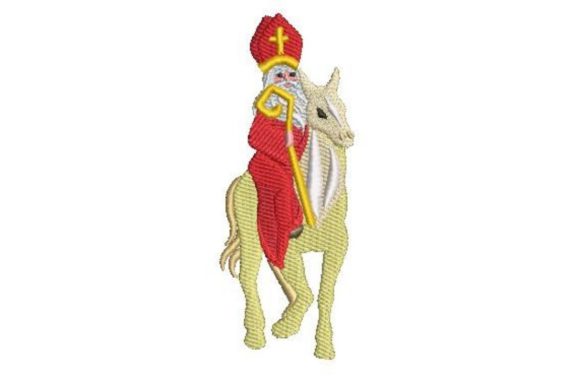
When I opened Sinterklaas on Horse for the first time, I didn’t see just another holiday embroidery file—I saw a character with presence. The composition balances tradition and approachability: Sinterklaas sits upright but warmly, his cape flowing gently behind, horse poised mid-step with quiet energy. It’s not overly ornate, but it’s not minimalist either—there’s thoughtful detail in the hat brim, the horse’s mane, and the subtle folds of the coat. This isn’t a design that shouts; it invites. That makes it ideal for handmade products where charm and craftsmanship matter more than flash.
A Real Project Test: Embroidering a Holiday Tote Bag for a Local Boutique
Last week, I used Sinterklaas on Horse on a natural canvas tote for a small-town gift shop’s winter collection. We stitched it centered on the front panel, sized to 4.2” wide—large enough to read clearly at arm’s length, small enough to leave room for hand-stitched initials on the corner. The result? A cohesive, boutique-ready piece customers paused to admire—not because it was loud, but because it felt intentional. The stitch density held up beautifully on medium-weight canvas, and the satin-stitched outlines gave clean definition without stiffness. Buyers commented on how “classic yet fresh” it looked—exactly the impression you want when selling a handmade product tied to cultural celebration.
Where It Shines (and Where It Needs Thought)
Sinterklaas on Horse works especially well for:
- Custom apparel: Sweatshirts, crewneck tees, and lightweight hoodies—especially on chest or upper-back placement. The vertical orientation reads clearly even at smaller sizes.
- Embroidered patch production: Clean outer edges and balanced negative space make it easy to cut and fuse. No awkward thread nests in tight corners.
- Baby embroidery: On onesies or burp cloths, its gentle scale and lack of fine text keep it safe, soft, and age-appropriate.
- Holiday gifts and nursery decor: Pillow covers, tea towels, and framed hoop art all benefit from its warm, storybook tone—without leaning into kitsch.
- Etsy seller assets: As a digital embroidery file, it pairs well with seasonal mockups. I tested it in grayscale and full-color previews—it translates cleanly across both, which matters for consistent branding.
But here’s what I watched closely—and recommend you do too:
- Small hoop sizes: Below 3.5”, some of the horse’s leg definition blurs. If you’re stitching on caps or tiny baby hats, test first—or consider simplifying the lower portion manually.
- Textured or stretchy fabric: On terry cloth towels or ribbed knit sweatshirts, use medium-cutaway stabilizer. The fill stitch areas are generous, and without support, they can ripple.
- Dark fabric backgrounds: The design relies on contrast for readability. On navy or charcoal, I switched to cream thread instead of white—it softened the look while keeping clarity. Always check your thread colors against your base fabric before committing.
- Frequent-wash items: For kitchen towels or children’s wear, confirm the stitch density feels dense enough for durability—but not so heavy it compromises drape. This design lands in that sweet spot, but verify with your machine’s tension settings.
Design Integrity Meets Commercial Practicality
As someone who evaluates hundreds of embroidery files a year for client work and my own craft business, I pay attention to how a design affects perceived value—not just aesthetics. Sinterklaas on Horse elevates a simple tote bag into something giftable. It signals care in curation, not just execution. That builds trust: customers don’t just buy embroidery—they buy confidence in your taste and skill.
For Etsy sellers and small shop owners, this matters doubly. A strong holiday embroidery file like this one helps your listings stand out in crowded search results—not because it’s flashy, but because it looks professionally considered. When layered into a printable mockup with warm lighting and natural textures, it reads as “designed,” not “downloaded.” And that distinction influences click-throughs, conversion, and repeat buyers.
Designer Notes You’ll Actually Use
Before stitching Sinterklaas on Horse into your next project, here’s my shortlist—based on real needle time:
- Test on scrap fabric first, especially if using textured weaves or blends. Not all “cotton canvas” behaves the same.
- Review stitch density visually—zoom in on your embroidery software. Look for long satin runs or tight fill clusters that might snag during trimming.
- Confirm hoop size compatibility. If your machine has a max 5×7 hoop, double-check whether the design fits comfortably with seam allowance room.
- Inspect small details: the horse’s eye, Sinterklaas’s glove stitching, and cape edge. Are they defined enough for your intended scale?
- Try black-and-white mockups. If it reads clearly without color, your finished product will hold up across fabric shades.
- Use proper stabilizer—cutaway for knits, tear-away for stable wovens. Skipping this step is the fastest way to turn a great embroidery file into a puckered disappointment.
- Verify licensing. Since this is a commercial embroidery design, confirm whether resale of finished items is permitted—and whether digital redistribution (e.g., bundling in a craft bundle) is allowed.
Final Thought: A Design That Fits Its Moment
Sinterklaas on Horse doesn’t try to be everything. It’s not a maximalist statement piece, nor is it a stripped-down icon. It’s a well-paced, culturally grounded machine embroidery design with quiet confidence—and that’s rare. Whether you’re embroidering a personalized gift for a Dutch family, building a holiday capsule collection for your small shop, or creating digital design assets for other makers, it delivers consistency without compromise. In a season full of noise, it offers warmth, recognition, and real-world usability. That’s not just good embroidery. That’s good business.